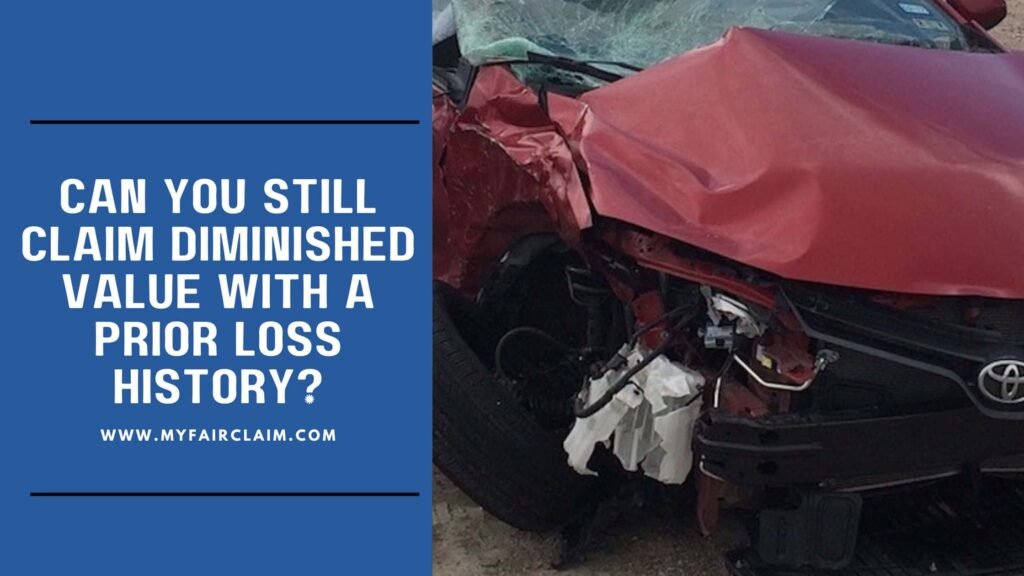
Yes. You can still claim diminished value even if your vehicle had prior accidents. Each new accident causes an additional, measurable loss in market value, calculated from your vehicle’s current pre-accident value, not from its original clean-history price.
Insurance companies often argue that a prior accident eliminates or severely limits a new diminished value claim. That position is incorrect.
Legally and economically, each collision creates a separate loss, and you are entitled to recover the incremental drop in value caused by the most recent accident.
This guide explains how diminished value works when a vehicle already has an accident history, how insurers attempt to deny these claims, and how to calculate and document the additional loss properly.
What Diminished Value Really Measures
Diminished value is the difference between:
- A vehicle’s fair market value immediately before an accident, and
- Its fair market value after repairs are completed
When a vehicle already has an accident history, that history is already reflected in its pre-accident market value. That adjusted value becomes the legitimate baseline for any new diminished value claim.
In other words, prior accidents do not disappear, but they also do not cancel out future losses.
Why Prior Accidents Do Not Eliminate a New Claim
A common insurance argument sounds like this:
“Your vehicle already had diminished value, so there’s little or nothing left to claim.”
This confuses two separate concepts:
- Original clean-history value (irrelevant to a new claim), and
- Current market value before the new accident (the correct legal baseline)
If your vehicle was worth $22,000 immediately before the latest accident, already accounting for prior damage, and repairs reduced that value to $18,500, you suffered a $3,500 additional loss. That loss exists regardless of what happened years earlier.
Each accident is a separate event with separate economic consequences.
How Insurance Companies Use Prior Accidents to Reduce Payouts
1. Baseline Confusion
Adjusters often compare your post-repair value to a clean-history price, then argue that most of the loss “already existed.” The law does not support this comparison. Only the current pre-accident value matters.
2. Double-Counting Prior Damage
Some insurers calculate diminished value from a vehicle’s already-reduced value, then apply an extra penalty for prior accidents. This double-counts the same loss and artificially suppresses payouts.
3. “Minimal Remaining Value” Claims
Insurers may argue that vehicles with accident history have little value left to lose. In real markets, the opposite is true.
Multiple-accident vehicles experience compounding stigma, and each additional accident often causes a larger percentage drop than the first.
Real-World Market Behavior
Used-vehicle data consistently shows compounding loss:
| Accident History | Typical Total Value Loss |
|---|---|
| Clean → 1 accident | 12–18% |
| 1 → 2 accidents | 25–35% |
| 2 → 3 accidents | 40–55% |
Buyers view multi-accident vehicles with increasing skepticism. The incremental loss from later accidents does not shrink; it often grows.
The Legal Standard (In Plain English)
Courts generally measure diminished value as:
The difference in fair market value immediately before and immediately after the accident.
That standard applies even when:
- The vehicle had prior accidents
- The owner did not claim diminished value previously
- The prior damage occurred before the current owner purchased the vehicle
Prior accidents lower the starting value, but do not remove the right to recover additional loss caused by a new collision.
How to Calculate Diminished Value With Prior Accident History
Step 1: Establish the Current Pre-Accident Value
This is the vehicle’s fair market value right before the new accident, reflecting any prior history.
Common sources include:
- Recent trade-in or dealer appraisals
- Comparable vehicle listings with similar accident history
- Market guides adjusted for condition and history
Step 2: Determine Post-Repair Market Value
After repairs, the vehicle now carries an additional accident on its record. Post-repair value reflects:
- Total accident count
- Damage severity
- Mileage and age
This value is best supported with:
- Comparable sales of similarly damaged vehicles
- Post-repair dealer offers
- Professional market appraisals
Step 3: Calculate the Incremental Loss
Formula:
Pre-Accident Value – Post-Repair Value = Additional Diminished Value
That difference represents the new loss caused solely by the most recent accident.
Why Standard Insurance Formulas Fail With Prior Accidents
Many insurers rely on rigid formulas (such as 17c-based methods) that:
- Ignore compounding stigma
- Do not distinguish between baseline loss and incremental loss
- Penalize vehicles multiple times for the same prior damage
These methods routinely undervalue multi-accident vehicles and are not based on real market behavior.
A proper evaluation focuses on actual market comparisons, not fixed caps.
When Professional Documentation Becomes Critical
Claims involving prior accidents are disputed more aggressively because:
- Baseline value is harder to establish
- Incremental loss must be clearly isolated
- Settlement amounts are often higher
Professional fair-market appraisals help by:
- Establishing a defensible pre-accident baseline
- Documenting real sales data
- Demonstrating the additional loss caused by the new accident
This documentation often determines whether a claim is reduced or paid fairly.
Common Objections and How They’re Addressed
“The prior accident already reduced your value.”
That reduction is already included in the pre-accident baseline. The claim only seeks the new loss.
“You can’t prove which accident caused the loss.”
The law uses the current pre-accident value specifically to avoid this issue. The difference after repairs represents the new loss.
“Multi-accident vehicles don’t really sell.”
They do, at documented discounts. If a vehicle had no value left, insurers would owe the entire remaining market value.
State Law Considerations (High-Level)
While state rules vary, most jurisdictions recognize that:
- Property damage includes loss of market value
- Prior damage may affect valuation but not eligibility
- Third-party claims are generally stronger than first-party claims
Because rules differ by state, documentation quality often matters more than statutory wording.
Practical Action Plan
- Document the pre-accident value immediately
Save any recent appraisals, offers, or listings. - Preserve, repair, and accident records
Keep estimates, invoices, and photos. - Compare similar vehicles with matching accident history
Focus on the total accident count before vs. after. - Challenge “already diminished” arguments with market data
Keep the discussion anchored to the baseline value.
Key Takeaway
A prior accident does not eliminate your right to claim diminished value.
What matters is this:
- Your vehicle had a legitimate market value before the new accident
- The new accident reduced that value further
- That difference is a real, recoverable loss
Insurance companies rely on confusion around prior damage to reduce payouts. Understanding how baseline value works and documenting it properly can make the difference between a minimal offer and a fair settlement.
Ready to Claim the Diminished Value You’re Owed?
If your vehicle lost value after an accident, even with prior damage history, you may be entitled to thousands more than insurance companies initially offer.
Our diminished value claim specialists analyze your vehicle’s true market loss, document the incremental damage, and help you recover what insurers often ignore or deny.
✔ Professional diminished value appraisal
✔ Market-based valuation (not insurance formulas)
✔ Support for vehicles with prior accidents
✔ Fast, claim-ready documentation
👉 Contact Now to Start your Diminished Value Claim Today
Continue Your Research
- get a professional diminished value report
- diminished value laws by state
- how major insurers handle DV claims

Roger Fuentes is trained in vehicle appraisal methodology and serves as Director of Claims Services at MyFairClaim, covering both first-party and third-party diminished value scenarios across all 50 states. His work centers on the intersection of vehicle valuation, insurer settlement practices, and claimant documentation – helping vehicle owners understand what a fair outcome actually looks like and how to pursue it. Roger writes to cut through the jargon that insurers rely on and give claimants a clearer picture of where they stand.