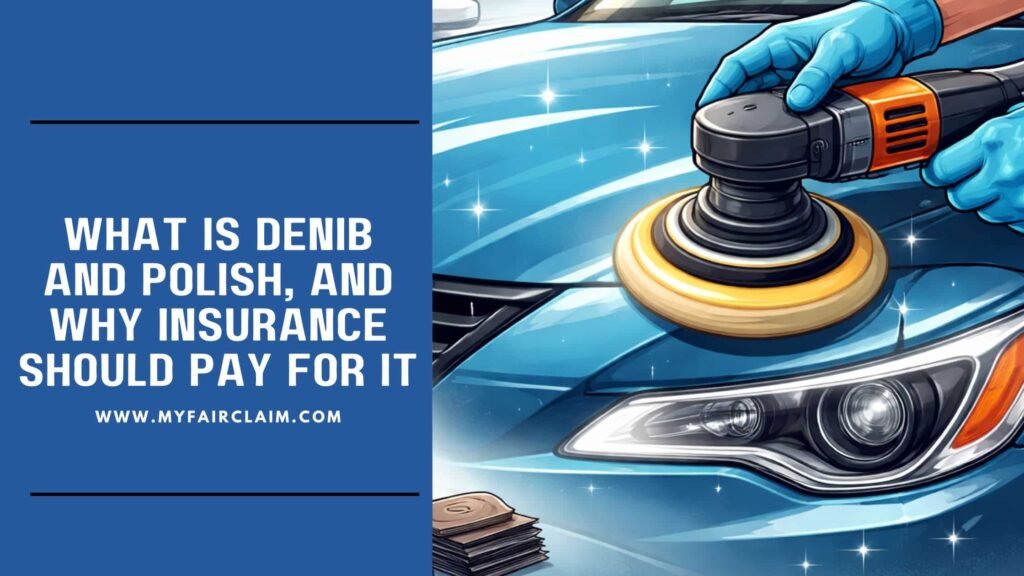
After collision repairs, you expect your car to look perfect. But what about the small imperfections in the paint finish? This is where denib and polish come in, and yes, insurance should pay for it.
We will explain what denibbing and polishing are, why they’re necessary, and why insurance companies must cover this essential repair process.
What Is Denib and Polish?
Denib and polish is the process of removing small imperfections from a freshly painted surface to restore a showroom-quality finish.
During the painting process, dust particles, lint, and other contaminants inevitably settle into the wet paint or clear coat before it’s cured.
This creates small bumps called “dirt nibs” that make the finish feel rough and look uneven.
The process involves:
- Sanding or scraping the dirt particle down
- Wet sanding with fine-grit sandpaper, typically using 1500-2000 grit sandpaper
- Buffing the sanded area to remove the sanding scratches
- Final polish to remove buffing swirl marks
This is not the same as color sand and buff, which would include sanding the entire painted surface to remove “orange peel” or texture from the clear-coated surface.
Why Denib and Polish Is Necessary
Denib and polish is not optional detailing work. It is a required step to return your vehicle to pre-accident condition.
Automakers Use This Process
All major automakers perform denib and polish in their factory paint facilities. The vehicle manufacturers have confirmed this in official bulletins.
If the manufacturers working in controlled, ultra-clean environments need this process, collision repair shops working with damaged vehicles absolutely require it.
Nissan recognizes that denib and polish may be necessary to achieve the appearance of a factory finish, and further finish sanding of the entire panel to achieve the correct texture.
This is outlined in their position statement published December 18, 2018: INFINITI Denib, Polish, and Finish Sand Position Statement (PDF)
Paint Manufacturers Require It
Every major paint manufacturer—including Axalta, BASF, Akzo Nobel, and others—has published statements confirming that denib and polish is both normal and suggested when using their products.
BASF specifically recommends sanding, polishing, and denibbing to achieve proper texture matching, as outlined in their official guidance: BASF Sand, Polish, and Denib Position Statement (PDF)
Collision repair shops cannot duplicate the application and dirt isolation processes used by automakers, making dust and dirt particle removal from the finish inevitable.
Shop Environment Makes It Unavoidable
Unlike factory paint booths that work with clean body shells, collision repair shops handle:
- Damaged vehicles with existing contamination
- Multiple repairs are happening in the same facility
- Sanding of body fillers, which creates floating dust particles
- Door openings that allow airborne particles into paint booths
Even the cleanest, most well-maintained shop cannot eliminate all contamination. Denib and polish address the reality of the repair environment.
Is Denib and Polish Included in Other Operations?
No. Denib and polish is a separate, not-included operation.
All three major estimating systems clearly list denib and polish as a standalone procedure:
- Mitchell’s Procedural Pages
- CCC One’s MOTOR Guide
- Audatex’s Database Reference Manual
These systems do not include denib and polish in refinishing labor, and outline it as a separate operation.
How Much Time Does Denib and Polish Take?
Estimating systems provide formulas for calculating denib and polish time. For example, CCC’s MOTOR Guide provides a formula for calculating denib and polish:
Each panel requires wet sand, rub-out, and/or buff (refinish or blend)
HOOD, ROOF, TRUNK LID, SPOILER
First panel add 20% of the full base refinish time, each additional panel add 10%.
FENDER, DOOR, QUARTER PANEL, BUMPER COVER
First panel add 10% of the full base refinish time, each additional panel add 5%.
Why Some Insurance Companies Resist Paying for Denib and Polish
Despite clear recommendations from both OEM’s and coating manufacturers, some insurers try to avoid paying for denib and polish by claiming:
- It’s included in refinish labor
- It’s only needed if the shop is dirty
- The shop should prevent contamination, or are lacking proper booth conditions
These arguments contradict manufacturer statements, as manufacturer conditions are unachievable by any repair facility performing collision repairs.
How to Ensure Insurance Pays for Denib and Polish
1. Document the Need
Have your repair shop document contamination and finish defects with photos before denib and polish.
2. Reference Industry Standards
Point to manufacturer position statements, paint company statements, and estimating system procedure pages that support that denib and polish are required.
3. Show It’s Not Included
Provide copies of the estimating system procedural pages showing denib and polish as a separate, not-included operation.
4. Calculate Proper Time
Use the estimating system formulas to show the appropriate time allowance based on refinish hours.
5. File a Proper Claim
If the insurer refuses payment, file a formal complaint documenting why the operation is necessary and not included elsewhere.
Does Denib and Polish Affect Diminished Value?
When done properly, denib and polish restore factory appearance and do not create additional diminished value.
However, if an insurer refuses to pay for denib and polish, forcing the shop to skip this step, the resulting poor finish quality could increase your vehicle’s value loss.
A rough, contaminated finish signals poor repair quality to future buyers. This can add 5% to 10% to your diminished value claim on top of the collision damage history.
Should Insurance Pay for Denib and Polish?
Yes. Denib and polish is a necessary, industry-standard operation required to return your vehicle to pre-accident condition.
The evidence is overwhelming:
- Automakers use it in factory paint facilities
- All major paint manufacturers confirm that it may be required
- Estimating systems list it as a separate, not-included operation
- Repair standards require it for quality finishes and appearance
Insurance companies that refuse payment are denying proper repairs and violating their policy obligations. Document the need, reference industry standards, and insist on proper compensation.
FAQs
Q. What is the difference between denib, polish, color sand, and buff?
Color sand and buff is an outdated term from lacquer paint days, when sanding brought out the paint’s luster. Color sand and buff is now typically performed to sand down excessive clear coat texture, and match the pre-existing texture. Denib and polish remove contamination from modern base coat and clear coat finishes.
Q. Is denib and polish covered by insurance?
Yes. Insurance must pay for denib and polish because it’s a necessary operation to restore the pre-accident condition. It’s confirmed by manufacturers and listed as not included in estimating systems.
Q. How much does denib and polish cost?
Cost depends on the number of refinish hours. Most estimating systems roughly use 0.2 to 0.3 hours of denib and polish time per refinish hour at the shop’s labor rate.
Q. Can a shop skip denib and polish if insurance won’t pay?
Shops should not skip denib and polish. Doing so leaves contamination and prevents the pre-accident condition.
Q. Why do insurance companies refuse to pay for denib and polish?
Some insurers incorrectly claim it’s included in refinish labor or is unnecessary. Both claims contradict industry documentation and estimating system guidelines.
Q. Does denib and polish damage the paint?
No. When performed correctly using proper techniques and materials, denib and polish improve the finish without damaging the paint or clear coat once properly buffed and polished.
Q. Is denib and polish required on every repair?
Nearly every repair requires some level of denibbing and polishing due to unavoidable contamination. The amount varies based on conditions and the size of the repair.
Q. What if my insurer says their estimate doesn’t include denib and polish?
Provide documentation showing it’s a not-included operation in their own estimating system. Reference manufacturer statements confirming it’s necessary.
Q. Can I get denib and polish on a diminished value claim?
If the insurer refuses to pay for denib and polish during repairs, and the poor finish quality reduces your car’s value, this can strengthen your diminished value claim.
Q. Does MyFairClaim help with denib and polish disputes?
Yes. MyFairClaim specializes in helping vehicle owners document and recover proper compensation for all necessary repairs, including denib and polish coverage disputes.
Continue Your Research
Roger Fuentes is trained in vehicle appraisal methodology and serves as Director of Claims Services at MyFairClaim, covering both first-party and third-party diminished value scenarios across all 50 states. His work centers on the intersection of vehicle valuation, insurer settlement practices, and claimant documentation – helping vehicle owners understand what a fair outcome actually looks like and how to pursue it. Roger writes to cut through the jargon that insurers rely on and give claimants a clearer picture of where they stand.