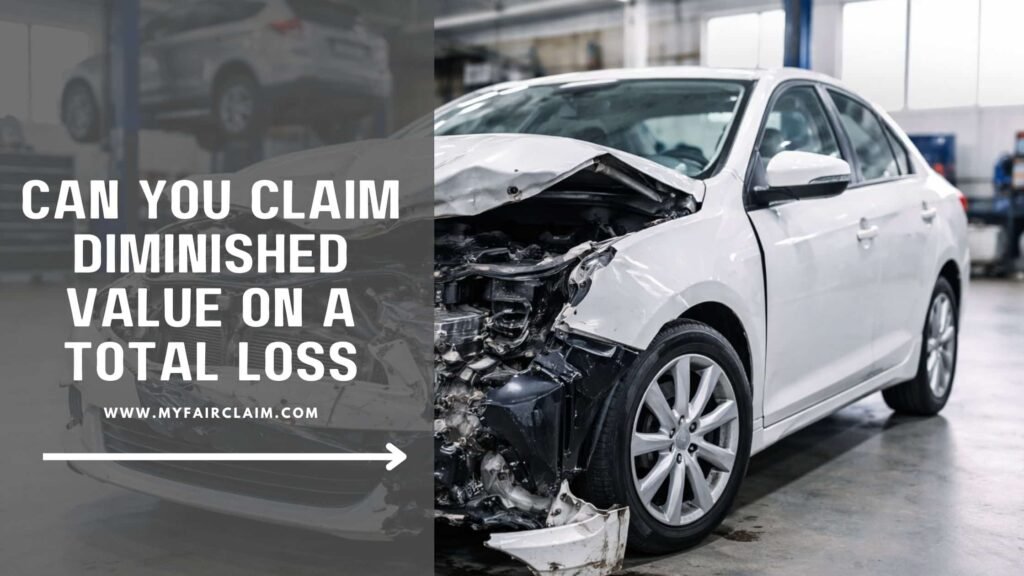
You generally cannot claim diminished value on a total loss vehicle. Diminished value applies to cars that are repaired after an accident and lose resale value due to accident history. When a vehicle is declared a total loss, insurance companies pay the car’s full pre-accident market value, eliminating the need for a diminished value claim.
What Is a Total Loss in Auto Insurance?
A total loss occurs when repairing a damaged vehicle costs close to or more than its pre-accident market value. Insurance companies typically declare a vehicle totaled when repair costs reach 70–80% of its actual cash value (ACV).
Instead of paying for repairs, the insurer compensates the vehicle owner for the vehicle’s value immediately before the accident.
Example of a Total Loss Settlement
| Scenario | Amount |
| Pre-accident vehicle value | $24,000 |
| Estimated repair cost | $19,000 |
| Insurance repair threshold | 75% |
| Result | Vehicle declared a total loss |
The insurance company would typically pay around $24,000 minus deductibles, and the damaged vehicle becomes salvage.
Can You Claim Diminished Value on a Total Loss?
In most situations, you cannot claim diminished value on a totaled vehicle.
Diminished value claims apply only when a vehicle is repaired and returned to the used car market. If the vehicle is declared a total loss, the insurance company compensates you for the entire pre-accident market value.
It means there is no remaining asset whose value has diminished.
Since the vehicle is no longer sold as a repaired car, there is no additional loss in resale value to claim.
Why Diminished Value Does Not Apply to Total Loss Cases
Diminished value exists because accident history lowers the resale value of repaired vehicles. However, total loss settlements function differently.
When a vehicle is totaled:
- The insurance company determines that the car is economically irreparable
- The insurer pays the actual cash value before the accident
- The damaged vehicle is typically classified as salvage
- Ownership of the vehicle often transfers to the insurance company
Because the owner receives compensation equal to the car’s full market value before the crash, diminished value claims typically do not apply.
Total Loss vs Diminished Value
| Factor | Total Loss Claim | Diminished Value Claim |
| Vehicle condition | Not economically repairable | Repaired after accident |
| Compensation | Pays full pre-accident value | Pays loss in resale value |
| Vehicle ownership | Usually transferred to insurer | Owner keeps vehicle |
| Market presence | Vehicle removed from market | Vehicle sold with accident history |
| Claim type | First-party or third-party | Usually third-party |
Total loss settlements compensate the entire vehicle value, while diminished value claims compensate for lost resale value after repairs.
Situations That Often Cause Confusion
1. Disputing a Total Loss Settlement
Sometimes insurance companies undervalue the vehicle when determining its pre-accident market value. If you believe the settlement is too low, you may dispute the valuation.
Common ways to challenge a settlement include:
- Providing comparable vehicle listings
- Showing maintenance or upgrade records
- Requesting an independent vehicle appraisal
- Using the appraisal clause in the insurance policy
This process may increase your payout, but it does not create a diminished value claim.
2. Keeping the Vehicle as Salvage
Some vehicle owners choose to keep their totaled car as salvage instead of surrendering it to the insurer. In this case, the insurance company deducts the salvage value from the settlement.
However, vehicles with salvage titles already have significantly reduced resale value, so diminished value claims are generally not applicable.
Incorrect Total Loss Determination
In rare situations, insurers may incorrectly classify a repairable vehicle as a total loss.
If the vehicle owner disputes this decision and the vehicle ends up being repaired instead, the owner may then pursue a diminished value claim because the repaired vehicle will still have accident history.
When You Can Claim Diminished Value
You may qualify for a diminished value claim if:
- Your vehicle was repaired after an accident
- Another driver was at fault
- The vehicle retains significant resale value
- Accident history can be proven to reduce its market price
Professional appraisal services can help determine the exact amount of lost value.
We, here at MyFairClaim, provide independent diminished value appraisals that help drivers support their claims during insurance negotiations.
How Diminished Value Is Calculated
Insurance companies often estimate diminished value using the 17c formula, which considers several factors.
Typical Calculation Factors
- Pre-accident vehicle value
- Maximum diminished value cap (often 10%)
- Damage severity multiplier
- Mileage adjustment
Many experts believe the 17c formula significantly underestimates real market loss. Which is why independent appraisal reports can help maximize claim compensation.
Get a Professional Diminished Value Appraisal
If your vehicle was repaired after an accident, you may still be entitled to recover the loss in resale value caused by the crash.
Unfortunately, many insurance companies undervalue diminished value claims or fail to inform drivers about their rights.
MyFairClaim helps vehicle owners recover the compensation they deserve through professional diminished value appraisals and claim support.
Our services include:
- Independent diminished value appraisal reports
- Market-based vehicle valuation analysis
- Insurance claim documentation support
- Assistance with negotiating fair compensation
If your vehicle was repaired after an accident and another driver was responsible, you may still be eligible for a diminished value claim.
Use the MyFairClaim Diminished Value Calculator to estimate your vehicle’s lost value today.
People Also Ask
Can a totaled car have diminished value?
No. A totaled car does not qualify for diminished value because the insurance company already compensates the owner for the vehicle’s full pre-accident market value.
What happens if your vehicle is declared a total loss?
When a car is declared a total loss, the insurance company pays the vehicle’s actual cash value before the accident, and the damaged vehicle typically becomes salvage.
Can you dispute a total loss valuation?
Yes. You can challenge the insurer’s valuation by providing comparable vehicle listings, maintenance records, or independent appraisal reports.
Is diminished value only for repaired vehicles?
Yes. Diminished value applies when a vehicle is repaired after an accident, and its resale value decreases due to accident history.
Key Takeaways
- Diminished value claims apply to repaired vehicles that lose resale value after an accident.
- Total loss settlements compensate the entire pre-accident vehicle value.
- Because the vehicle is not repaired and returned to the market, diminished value usually cannot be claimed on a totaled vehicle.
- If the insurer undervalues your car in a total loss settlement, you can dispute the valuation instead of filing a diminished value claim.
More on Diminished Value

Roger Fuentes is trained in vehicle appraisal methodology and serves as Director of Claims Services at MyFairClaim, covering both first-party and third-party diminished value scenarios across all 50 states. His work centers on the intersection of vehicle valuation, insurer settlement practices, and claimant documentation – helping vehicle owners understand what a fair outcome actually looks like and how to pursue it. Roger writes to cut through the jargon that insurers rely on and give claimants a clearer picture of where they stand.