
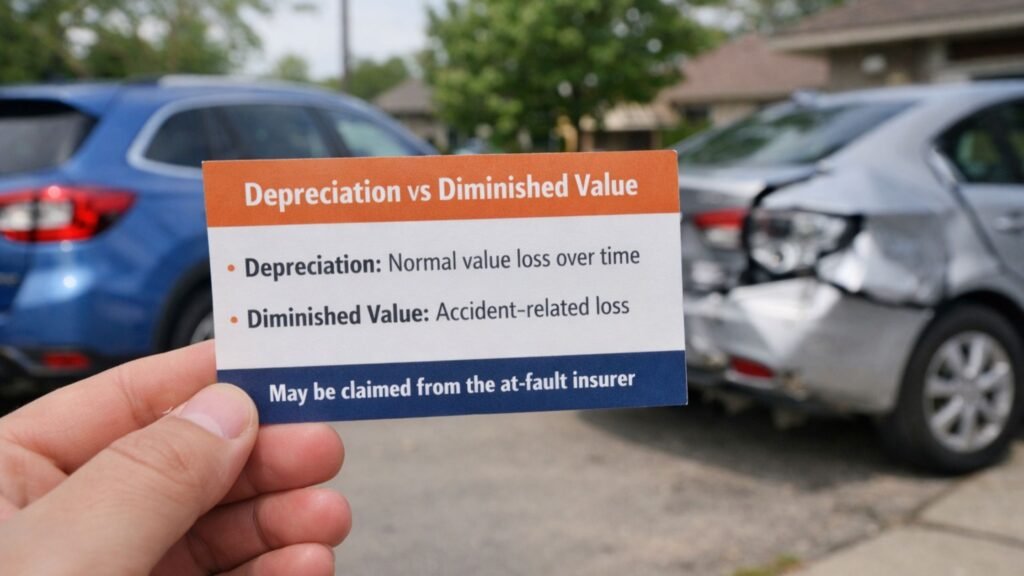
When your vehicle loses value, it can happen for two main reasons: depreciation or diminished value. Although these terms are often confused, they refer to different types of financial loss.
If you were recently involved in a car accident, understanding the difference between diminished value and depreciation can help you determine whether you are entitled to compensation from an insurance company.
This guide explains both terms in clear, structured language to help you make informed decisions.
What Is Depreciation?
Depreciation is the gradual decrease in a vehicle’s value over time. It happens naturally and affects every vehicle, regardless of whether it has been in an accident.
A car begins to depreciate as soon as it is driven off the dealership lot. The loss in value continues each year due to:
- Age of the vehicle
- Mileage accumulation
- Wear and tear
- Market demand changes
- Release of newer models
For example, a new car can lose 15% to 25% of its value within the first year. After five years, many vehicles lose up to 50% or more of their original purchase price.
Depreciation is predictable and unavoidable. Insurance companies do not reimburse owners for depreciation because it is considered a normal part of vehicle ownership.
What Is Diminished Value?
Diminished value is the reduction in a vehicle’s market value after it has been involved in an accident and repaired.
Even if the repairs are completed correctly and the vehicle looks like new, the accident history remains on vehicle history reports. Buyers typically pay less for a vehicle that has a recorded accident.
The difference between the vehicle’s value before the accident and its value after proper repairs is called diminished value.
In simple terms:
- Depreciation happens because of time and usage.
- Diminished value happens because of accident damage.
Diminished Value vs Depreciation Comparison at a Glance
Depreciation is the natural loss of a car’s value over time due to age, mileage, and wear. Diminished value is the drop in market value after an accident, even if repairs are completed. Depreciation is not covered by insurance, but diminished value may be claimed from the at-fault driver’s insurer.
The following table clearly outlines the differences between diminished value and depreciation:
| Feature | Depreciation | Diminished Value |
| Definition | Natural loss of value over time | Loss of value due to accident history |
| Cause | Age, mileage, wear, market trends | Collision or accident damage |
| Affects All Vehicles? | Yes | Only vehicles involved in accidents |
| Timing | Gradual and continuous | Occurs immediately after an accident |
| Insurance Coverage | Not covered | May be covered (third-party claim) |
| Preventable? | No | Depends on accident circumstances |
| Documentation Required | No special documentation | Depends on the accident circumstances |
| Repair records and appraisal reports are often needed | Expected and predictable | Often sudden and significant |
Key Differences Between Diminished Value and Depreciation
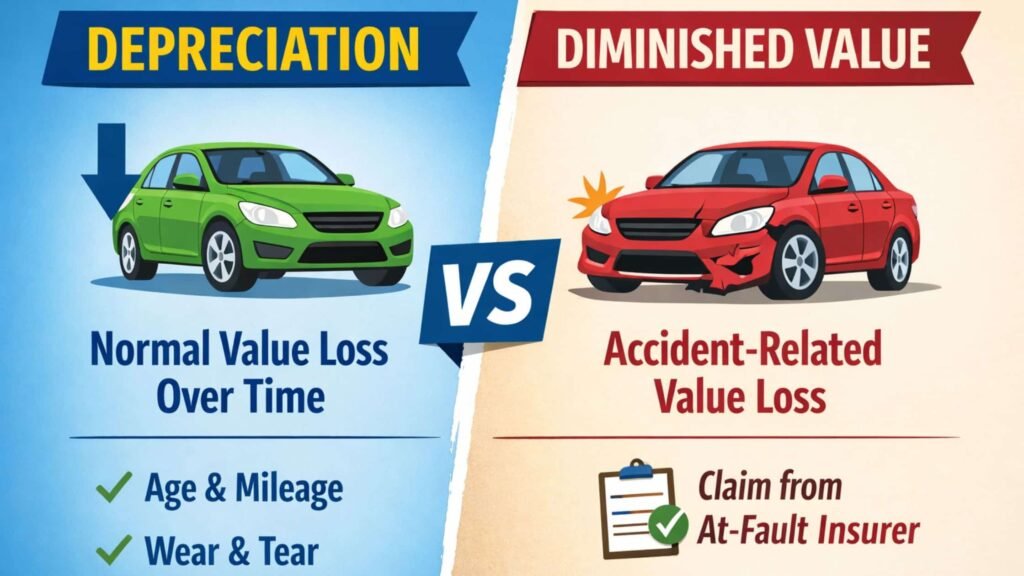
Depreciation affects all vehicles and occurs gradually over time. It is caused by age, mileage, and general market conditions. It does not require an accident to occur.
Diminished value only affects vehicles that have been damaged in a collision. It occurs immediately after the accident and continues even after repairs are completed.
Another major difference is insurance treatment. Depreciation is not covered by insurance. Diminished value may be recoverable if another driver caused the accident and state laws allow it.
Depreciation vs Diminished Value Example
Consider this example:
You purchase a vehicle for $30,000. After three years of normal depreciation, its market value drops to $20,000. The $10,000 loss is standard depreciation.
Then you are involved in an accident that was not your fault. After professional repairs, similar accident-free vehicles still sell for $20,000. However, your vehicle sells for only $17,500 due to its accident history.
The additional $2,500 reduction is diminished value. That amount may be eligible for recovery through a third-party insurance claim.
When Can You File a Diminished Value Claim?
You may qualify for a diminished value claim if:
- Another driver was at fault
- Your vehicle sustained measurable damage
- The vehicle is relatively new or has low mileage
- Your state recognizes diminished value claims
Luxury vehicles and newer models often experience higher diminished value losses because buyers are more sensitive to accident history.
It is important to file claims promptly and provide proper documentation, including repair records and professional appraisals.
How Insurance Companies Handle Diminished Value
Insurance companies do not automatically include diminished value in settlement offers. In most cases, you must request it separately.
Some insurers use internal formulas to calculate diminished value, which may reduce the payout amount. Because of this, obtaining an independent diminished value appraisal can strengthen your claim.
Depreciation, however, is never included in insurance compensation.
Why Understanding the Difference Matters
Confusing depreciation with diminished value can lead to financial loss. Many vehicle owners assume post-accident value reduction is normal depreciation and do not pursue compensation.
Understanding the distinction helps you:
- Evaluate settlement offers accurately
- Negotiate with insurance adjusters confidently
- Protect your vehicle’s resale value
- Recover losses caused by another driver
Knowledge of these terms allows you to make better financial decisions after an accident.
Frequently Asked Questions
Q. Is diminished value the same as depreciation?
No. Depreciation is the natural loss of value over time. Diminished value is the loss caused by accident history.
Q. Does insurance cover depreciation?
No. Depreciation is not covered because it occurs naturally.
Q. Can I claim diminished value from my own insurance company?
In most cases, diminished value claims are filed against the at-fault driver’s insurance. First-party claims depend on state laws and policy terms.
Q. Does a repaired car still lose value?
Yes. Even properly repaired vehicles often sell for less due to accident records.
Protect Your Vehicle’s True Value
If your car has been in an accident and you were not at fault, you may be entitled to recover diminished value compensation.
Don’t assume your insurance company will automatically include it in your settlement. Get a professional diminished value assessment, understand your vehicle’s true post-accident market loss, and take action before claim deadlines expire.
If you want to know how much your vehicle may have lost after an accident, consider using a reliable diminished value calculator or consulting a professional appraisal service. Protect your investment and make sure you receive the compensation you deserve.
Key Takeaways
Depreciation is unavoidable. Every vehicle loses value as it ages.
Diminished value is different. It is the financial loss caused by an accident, even after repairs are completed. If another driver caused the collision, you may have the right to seek compensation for that loss.
Understanding the difference between diminished value and depreciation ensures you do not overlook money that may be legally recoverable.

James Andrews serves as Senior Claims Specialist at MyFairClaim, focusing on denial reversals and complex diminished value cases. With over 12 years of battling insurance company denials, he has developed strategies that overturn 73% of initial rejections. His expertise in turning “hopeless” denials into successful recoveries has helped thousands recover money insurance companies insisted didn’t exist.
