
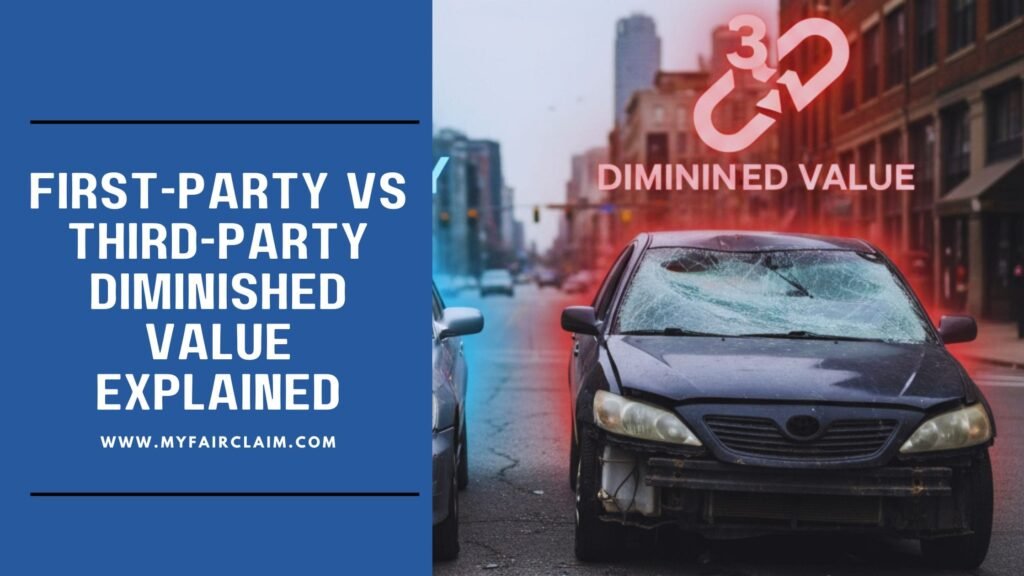
When your vehicle is damaged in an accident, the repair work may restore it mechanically, but the market value often drops.
This reduction is known as diminished value. Many car owners are surprised to learn they may be entitled to financial compensation for this loss.
However, your ability to recover depends on whether your claim is first-party or third-party.
Understanding the difference between these two types of claims is essential if you want to protect your rights and maximize your compensation.
What Is a First-Party Diminished Value Claim?
A first-party claim is when you file directly with your own insurance company.
Example: Imagine hitting a deer while driving. Even though the accident wasn’t caused by another driver, your vehicle’s value still drops after repairs.
In this case, you would request diminished value compensation from your insurer.
However, the reality is that first-party diminished value claims are often harder to win. Here’s why:
- Most auto insurance policies do not clearly state whether diminished value is covered
- Some states allow recovery under first-party coverage, while others do not
- Whether you can recover depends largely on where the accident happened and the exact wording of your policy
At My Fair Claim, our specialists review your case and confirm whether your state and policy allow a diminished value recovery directly through your insurer.
What Is a Third-Party Diminished Value Claim?
A third-party claim is filed against the insurance company of the at-fault driver.
Example: Another driver rear-ends your car at a stoplight. Even after repairs, your car’s resale value drops because of its accident history.
In this situation, you would file a diminished value claim against the other driver’s insurance.
Third-party claims generally have a much higher success rate than first-party claims. Why?
- Under tort law, the at-fault driver (and their insurer) is responsible for fully compensating you for all losses, including diminished value
- Since you are the innocent party, you are legally entitled to recover the loss in your car’s market value
- Courts and insurance regulators have consistently recognized third-party diminished value as a legitimate claim
First Party vs. Third Party Diminished Value: A Quick Comparison
| Feature/Aspect | First Party Claim | Third Party Claim |
|---|---|---|
| Who You File With | Your own insurance company | At-fault driver’s insurance company |
| Typical Success Rate | Low (depends on policy and state) | High (widely recognized under tort law) |
| Coverage Limitations | Often excluded or restricted in policies | Generally covered as part of property damage liability |
| Best Case Scenario | Some states allow recovery if the policy permits | Strong chance of receiving full diminished value compensation |
| Legal Foundation | Contract law (policy wording) | Tort law (compensation for damages caused by another) |
| Compensation Potential | Limited, varies by insurer and state | Usually thousands of dollars, depending on the car’s value loss |
| Example Case | Hitting a deer and filing through your own insurer | Being rear-ended and filing a claim against the other driver’s insurer |
Diminished Value Claims Timeline – How Long Does It Take?
One of the biggest concerns car owners have is how long the claims process will take. The good news is that with professional help, diminished value claims often move quickly.
Here’s a typical timeline when handled by experienced diminished value specialists like My Fair Claim:
- Appraisal Ordered (Day 1): A professional appraisal of your vehicle’s post-accident market value is completed, often within 24 hours
- Submission to Insurance (Day 2–3): The appraisal and supporting documents are sent to the insurance company
- Insurance Review (Week 1–3): Adjusters review the claim and negotiate settlement terms
- Settlement (Within 30 Days): Many claimants receive settlement checks worth thousands of dollars in less than a month
Of course, timelines can vary depending on the insurer, state, and complexity of the case, but professional representation almost always speeds up the process.
Why Professional Guidance Matters
While it’s possible to file a diminished value claim on your own, insurance companies rarely make it easy. Common challenges include:
- Denials based on technical policy language
- Low settlement offers that don’t reflect the true market loss
- Delays in processing or communication
That’s why working with a diminished value specialist is so important. At My Fair Claim, we:
- Provide free consultations to review your situation
- Handle the appraisal and claim submission process
- Negotiate directly with the insurance company on your behalf
- Maximize your chances of receiving the full compensation you deserve
Key Takeaways
- First-party claims involve filing with your own insurer, but are harder to win due to policy limits and state law variations
- Third-party claims are filed against the at-fault driver’s insurer and usually have a much higher success rate
- With professional help, most diminished value claims can be settled within 30 days, often resulting in thousands of dollars in compensation
- Expert guidance ensures you don’t leave money on the table and helps you navigate the insurance system effectively
Get Professional Help Today
Don’t navigate diminished value claims alone. Whether you’re filing a first-party claim in Georgia or a third-party claim anywhere else, professional representation dramatically improves your outcome.
Why Choose MyFairClaim?
✅ 2,000+ Successful Claims: Extensive experience with both first-party and third-party claims
✅ 94% Settlement Success Rate: We know what insurance companies require
✅ Instant Appraisals: Fast turnaround on comprehensive reports
✅ Expert Negotiation: We offer support for negotiations with insurance companies
✅ All 50 States: Qualified professionals serving nationwide
✅ No Upfront Risk: Most clients receive settlements worth thousands within 30 days
Simple 3-Step Process
Step 1: Submit your vehicle and accident information (>5 minutes)
Step 2: Receive your professional diminished value report (Instant)
Step 3: File and negotiate your claim to maximum settlement
Get Your Diminished Value Report

Roger Fuentes is a certified vehicle appraiser and Director of Claims Services at MyFairClaim. With over 15 years of experience specializing in both first-party and third-party diminished value claims, Roger has successfully processed more than 2,000 claims nationwide, achieving a 94% settlement success rate.
