
One of the most effective ways to request compensation is by submitting a diminished value claim letter. This letter explains the accident, describes the damage and repairs, and formally requests payment for the reduction in your vehicle’s market value.
This guide explains how to write a diminished value claim letter, what information it should include, and how to make the letter clear, professional, and effective.
What Is a Diminished Value Claim Letter?
A diminished value claim letter is a formal document sent to an insurance company requesting compensation for the reduction in a vehicle’s resale value after an accident. Even when repairs restore the vehicle to a safe and functional condition, the accident history often lowers the car’s market value.
Most buyers prefer vehicles that have never been involved in an accident. Once a vehicle has a repair record, it may appear on vehicle history reports and affect buyer confidence. Because of this, a repaired vehicle often sells for less than a similar vehicle with no accident history. A diminished value claim letter explains this loss and asks the insurer to compensate the vehicle owner.
When Should You Send a Diminished Value Claim Letter?
A diminished value claim letter is usually sent after the vehicle repairs are completed and the total repair costs are known. At this stage, you can provide accurate documentation about the damage, the repair work performed, and the vehicle’s current condition.
It is also helpful if the at-fault driver’s insurance company has already accepted liability for the accident. Once liability is confirmed and repairs are finished, you can gather repair invoices, photographs, and any appraisal reports that estimate the diminished value of the vehicle.
Including these documents with your claim letter strengthens your request and makes it easier for the insurance adjuster to evaluate your claim.
What Information Should Be Included in a Diminished Value Claim Letter?
A well-written diminished value claim letter should provide clear, structured, and factual information about the accident, the vehicle, and the financial loss caused by the incident.
Insurance adjusters review many claims, so presenting the information in a logical order helps them quickly understand your request and evaluate the diminished value of your vehicle.
Below are the key details that should be included in a diminished value claim letter.
1. Your Contact Information
Start the diminished value claim letter with your contact information so the insurance company can easily identify and communicate with you regarding the claim. This section should include your full name, mailing address, phone number, and email address.
It is also important to include the date of the letter and the contact details of the insurance company handling the claim. Providing this information at the beginning of the letter helps establish the context of the communication and ensures the claim adjuster can respond directly.
2. Insurance Claim Details
The next section should clearly reference the insurance claim related to the accident. Including accurate claim details helps the insurance adjuster quickly locate the claim file in their system.
Important information typically includes the claim number, the insurance company name, and the name of the policyholder involved in the accident. You should also mention the date and location of the accident so the insurer can easily connect your letter to the correct claim record.
3. Vehicle Information
Your diminished value claim letter should clearly identify the vehicle that was involved in the accident. This helps establish the vehicle’s identity and its condition before the collision occurred.
Include details such as the vehicle’s year, make, and model, along with the Vehicle Identification Number (VIN). It is also helpful to mention the vehicle’s mileage at the time of the accident and briefly describe its condition before the damage occurred. These details help demonstrate the vehicle’s pre-accident value and overall condition.
4. Accident Description
A brief and factual description of the accident should also be included in the letter. This section should explain when the accident happened and confirm that the other driver was determined to be at fault.
Focus on presenting clear facts rather than opinions or emotional language. Mention the type of damage your vehicle sustained and how the accident occurred. Providing this context helps the insurance company understand how the accident led to the repairs and the resulting diminished value.
5. Repair Details
Repair information is another important part of a diminished value claim letter. This section should explain where the vehicle was repaired and describe the damage that required repair.
You should also mention the total repair cost and the date when the repairs were completed. Referencing the repair invoice or estimate that you are attaching to the letter helps support your claim. Even though the vehicle may have been repaired properly, the accident record can still reduce its resale value in the used car market.
6. Diminished Value Amount
Your claim letter should clearly state the diminished value amount you are requesting. This amount represents the difference between the vehicle’s value before the accident and its value after repairs.
Ideally, this amount should be supported by an independent diminished value appraisal or a professional vehicle valuation report. These reports often analyze market comparisons, accident impact, and vehicle condition to estimate the financial loss caused by the accident. Including this documentation helps provide objective evidence for the compensation you are requesting.
7. Request for Compensation
The final section of the diminished value claim letter should clearly state your request for compensation. In this part of the letter, you formally ask the insurance company to reimburse you for the diminished value of your vehicle.
Your request should reference the documentation provided, such as repair invoices and appraisal reports, and explain that the accident caused a measurable loss in the vehicle’s market value. It is also helpful to politely request a response within a reasonable timeframe so the insurance company can review the claim and provide an update.
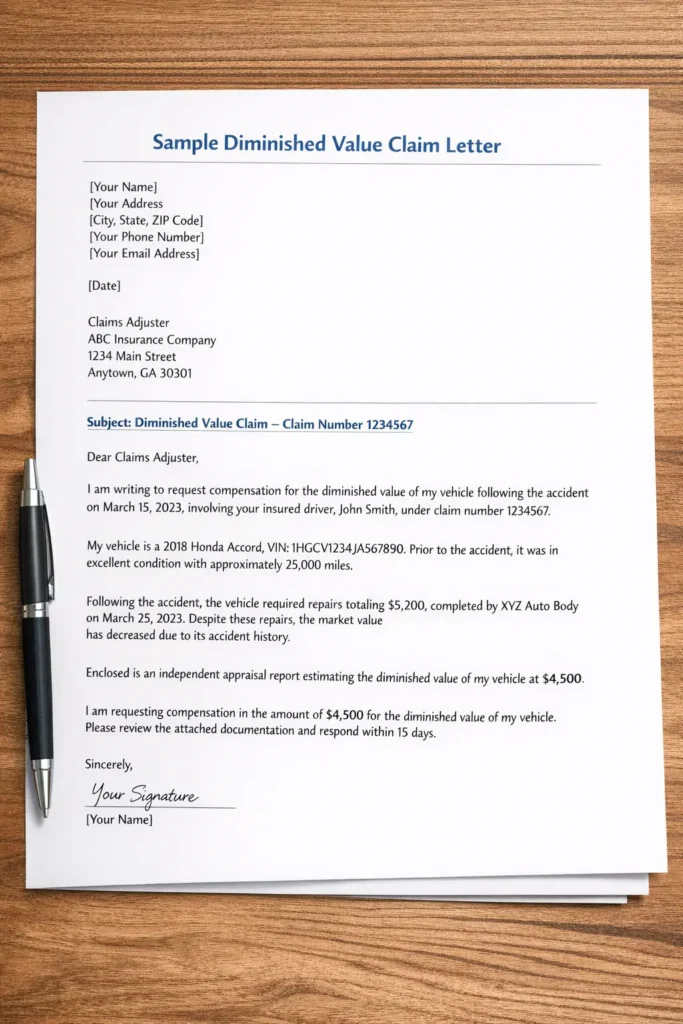
Sample Diminished Value Claim Letter
Below is an example of how a diminished value claim letter may be structured.
Subject: Diminished Value Claim – Claim Number [XXXX]
Dear Claims Adjuster,
I am writing to request compensation for the diminished value of my vehicle resulting from the accident that occurred on [date]. The accident involved your insured driver, and liability has been accepted under claim number [XXXX].
My vehicle is a [year, make, model] with VIN [VIN number]. Prior to the accident, the vehicle was in excellent condition with approximately [mileage] miles.
Following the accident, the vehicle required repairs totaling $[repair amount], which were completed at [repair shop name]. Although the vehicle has been repaired, it has experienced a reduction in market value because of its accident history.
An independent appraisal estimates the diminished value of my vehicle to be $[amount]. I have attached the appraisal report and repair documentation for your review.
Based on this information, I am requesting compensation in the amount of $[amount] for the diminished value of my vehicle. Please review the attached documents and respond within 15 days regarding this claim.
Sincerely,
[Your Name]
Tips for Writing an Effective Diminished Value Claim Letter
1. Maintain a Professional and Clear Tone
When writing a diminished value claim letter, clarity and professionalism are essential. The tone should remain polite and factual so that the insurance adjuster can easily review the request.
Avoid emotional language and focus on presenting verifiable information about the accident, repairs, and the resulting loss in vehicle value. A professional tone helps your claim appear credible and easier for the insurance company to evaluate.
2. Include Strong Supporting Documentation
Supporting documentation plays a major role in strengthening a diminished value claim. Including repair invoices, photos of the vehicle damage, vehicle history records, and independent appraisal reports can help demonstrate the actual reduction in the vehicle’s market value.
The more objective evidence you provide, the easier it becomes for the insurance company to understand the financial impact of the accident and review your request for compensation.
3. Keep the Letter Well-Structured and Easy to Read
It is also helpful to keep the letter structured and easy to read. Insurance adjusters review many claims each day, so a well-organized letter with clear sections allows them to quickly identify the most important details. Presenting the information in a logical order, such as accident details, vehicle information, repair records, and diminished value amount, makes the claim easier to process.
4. Follow Up With the Insurance Company
If you do not receive a response within the requested timeframe, following up with the insurance company can help keep the claim moving forward. A polite follow-up email or phone call may encourage the adjuster to review the documentation and provide an update on the status of your claim. Consistent but professional follow-ups can sometimes help speed up the claim review process.
Why a Professional Diminished Value Report Can Strengthen Your Claim
Insurance companies sometimes challenge diminished value claims if the requested amount is not supported by strong evidence. A professional diminished value report provides an independent assessment of the vehicle’s value before and after the accident.
These reports often analyze vehicle condition, repair history, comparable market sales, and the impact of accident records on resale value. Because the valuation is performed by an independent professional, it can add credibility to the claim and help justify the compensation being requested.
Get Help With Your Diminished Value Claim
Writing a diminished value claim letter is an important step in recovering the loss in your vehicle’s value after an accident. However, supporting your claim with an independent appraisal can significantly improve your chances of receiving fair compensation.
MyFairClaim helps vehicle owners obtain professional diminished value reports that document the true loss in a vehicle’s resale value. With a detailed appraisal report and a well-written claim letter, you can present a stronger case when negotiating with the insurance company.

James Andrews serves as Senior Claims Specialist at MyFairClaim, focusing on denial reversals and complex diminished value cases. With over 12 years of battling insurance company denials, he has developed strategies that overturn 73% of initial rejections. His expertise in turning “hopeless” denials into successful recoveries has helped thousands recover money insurance companies insisted didn’t exist.