
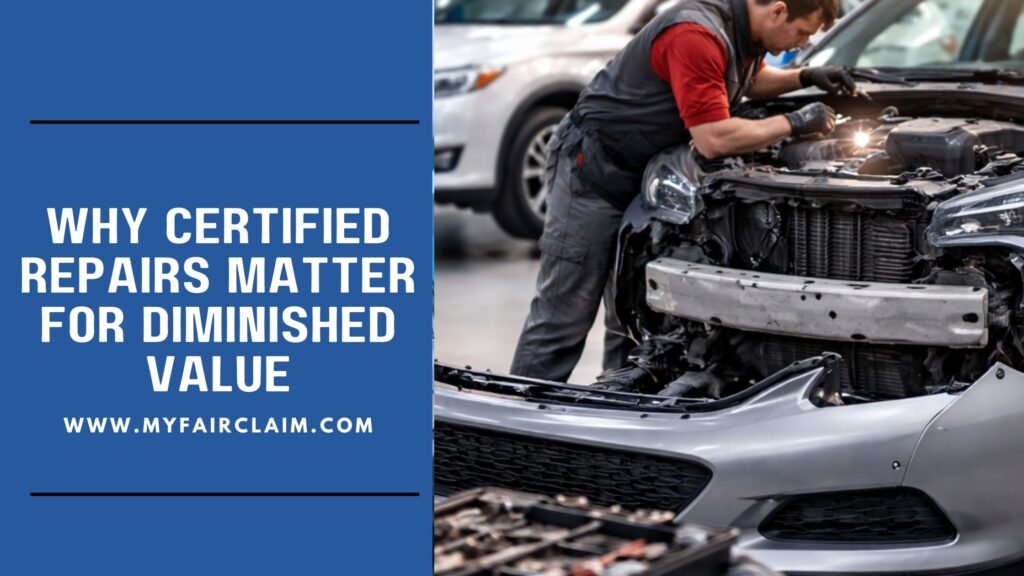
The sound of crunching metal is a noise no car owner ever wants to hear. Once the initial shock subsides and you ensure everyone is safe, your mind immediately races to the logistics: insurance calls, police reports, and the daunting prospect of repairs.
However, for many luxury and performance vehicle owners, the financial headache doesn’t end when the car rolls out of the shop. There is a secondary, often invisible cost that lingers long after the paint has dried: diminished value.
This is the painful reality that a vehicle with an accident history is simply worth less than one without it, even if it looks brand new.
If you are searching for a body shop near you, you likely already know that this difference in market value is the basis of a “diminished value” claim. However, simply filing a claim isn’t enough to win it.
To maximize your compensation, you must prove that your vehicle has been restored to its pre-loss condition physically, isolating the lost value strictly to its history rather than its current condition.
This is where the distinction between a general mechanic and a manufacturer-certified facility becomes the most critical factor in your case.
So, Why Certified Repairs Matter for Diminished Value?
Manufacturer-certified repairs prove your car was restored to factory standards using OEM parts and proper procedures. This removes “poor repair” arguments, isolates inherent diminished value, and strengthens your claim for maximum compensation.
The Two Enemies of Value
To understand why repair quality dictates your payout, you have to understand the two types of diminished value relevant to this discussion:
- Inherent Diminished Value: This is the loss of value simply because the car has an accident on its CarFax report. Even if repaired perfectly, public perception drives the price down. This is usually what you are trying to claim.
- Repair-Related Diminished Value: This is a loss of value due to poor workmanship. If a shop leaves visible tape lines, uses generic (non-OEM) parts that don’t fit quite right, or fails to align panels perfectly, the car is worth less because it is objectively inferior to its pre-accident state.
This distinction is the favorite loophole of insurance adjusters. If you take your car to a non-certified shop, an insurer can deny your diminished value claim by arguing that any loss in value is “repair-related.”
They will claim the vehicle would have retained its value if the shop had done a better job, effectively shifting the blame (and the financial liability) away from their policy and onto your chosen repair shop.
What is the Strategic Advantage of Certification?
This is why you cannot compromise on where you take your vehicle. By choosing a manufacturer-certified collision repair center, you are effectively removing the “repair-related” argument from the negotiation table.
A certified facility has been vetted, trained, and audited by the automaker – whether it is Tesla, Mercedes-Benz, Porsche, or Audi to ensure they follow precise factory protocols. When you use a certified shop, you ensure that:
- OEM Parts Are Mandatory: Certified shops are typically required to use Original Equipment Manufacturer (OEM) parts rather than aftermarket or “like kind and quality” (LKQ) parts. This maintains the integrity of the car and its warranty.
- Factory Blueprints Are Followed: Modern vehicles are engineered with complex crumple zones and advanced materials like aluminum and carbon fiber. Certified technicians follow the manufacturer’s specific blueprints for welding and bonding, ensuring the structural safety of the car is identical to when it left the factory line.
- Safety Systems Are Restored: Advanced Driver Assistance Systems (ADAS), like lane departure warnings and automatic braking, require precise calibration that general shops often overlook or outsource.
By securing a flawless, factory-approved repair, you force the conversation back to inherent diminished value.
You can look the adjuster in the eye and say, “The car is technically perfect; the loss in value is purely due to the accident record.” This is a much stronger position for negotiation.
Documentation Wins Arguments
A diminished value claim is essentially a legal argument supported by data. When you use a specialized facility, you receive a different level of documentation.
A certified shop will provide a detailed itemized list of every OEM part used, every procedure performed, and proof of post-repair scans and calibrations.
This paperwork is gold. When you submit your appraisal report to the insurance company, attaching the certified repair order serves as irrefutable proof that the vehicle was restored to factory specifications.
It signals to the insurance carrier that you are a knowledgeable owner who cares about the asset’s value. It makes it incredibly difficult for them to lowball you based on the condition of the vehicle.
Navigating the Insurance “Steer”
Finally, be wary of insurance “steering.” Insurers often pressure owners to use their Direct Repair Program (DRP) shops to cut costs and speed up turnaround times.
While these shops are convenient for the insurer, they often have agreements to use cheaper parts or skip time-consuming procedures that don’t affect the visual appearance but do affect the structural integrity.
You have the legal right to choose your repair facility. If your goal is to recover the thousands of dollars you lost in resale value, you must prioritize the quality of the repair over the convenience of the insurance company.
A subpar repair can double your financial loss – once from the accident history, and again when a future buyer points out the poor paint match.
Key Takeaways
Ultimately, a diminished value claim is about making you whole. By insisting on manufacturer-certified repairs, you build a fortress around your claim, ensuring your vehicle is safe, your warranty is intact, and your paper trail is undeniable.
Once your vehicle is properly restored, contact MyFairClaim to ensure you have the expert appraisal needed to recover the full value you are owed.
Roger Fuentes is a certified vehicle appraiser and Director of Claims Services at MyFairClaim. With over 15 years of experience specializing in both first-party and third-party diminished value claims, Roger has successfully processed more than 2,000 claims nationwide, achieving a 94% settlement success rate.
