
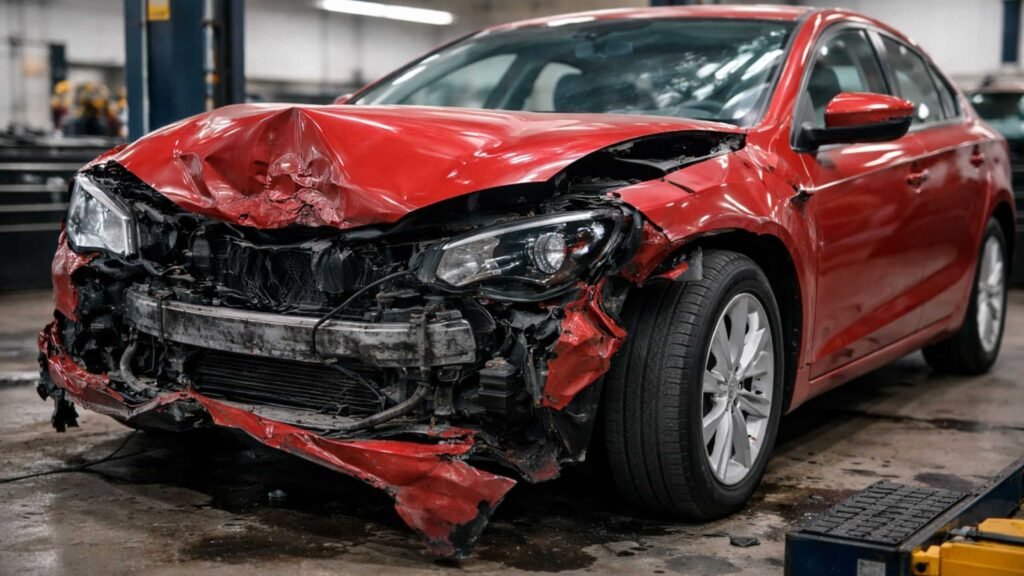
If you have ever tried to sell a car that has an accident on its Carfax report, you already know the conversation. The buyer pulls up the report on their phone, sees the words “accident reported,” and the price you were hoping to get gets quietly cut by thousands of dollars. Sometimes the buyer walks away entirely.
This is one of the most common, and most expensive, surprises vehicle owners face after a collision. The repairs were paid for. The car looks and drives perfectly. Yet the market treats it as a discounted asset for the rest of its life on the road.
This guide explains exactly how an accident entry on Carfax affects your car’s resale value, why the discount exists even on properly repaired vehicles, what you can do about an inaccurate entry, and how diminished value claims fit into the picture.
What Carfax actually shows
Carfax is a vehicle history reporting service that pulls data from more than 130,000 sources, including state DMVs, insurance carriers, repair facilities, auto auctions, police reports, and salvage yards. When something significant happens to a vehicle, it tends to get logged in the report.
The entries that affect resale value most are:
- Accident reported. A collision was logged through one of Carfax’s data sources. The entry usually specifies severity (minor, moderate, severe) and the area of impact (front, rear, side, multiple).
- Damage reported. Damage was reported but not necessarily from a confirmed accident. Hail, vandalism, and parking lot incidents often show up this way.
- Airbag deployment. Logged separately, and considered a strong indicator of moderate to severe impact.
- Structural or frame damage. The most aggressive entry. Buyers and dealers treat this almost identically to a salvage title for valuation purposes.
- Total loss. If an insurer declared the vehicle a total loss at any point, Carfax usually picks that up. Once flagged, resale value collapses.
Importantly, Carfax does not see every accident. If an incident was paid out of pocket, never reported to insurance, and never went through a body shop that reports to Carfax, it may not appear. The opposite is also true: a minor incident, sometimes one that did not even involve a real collision, can get logged and follow the car forever.
The real impact on resale value
The honest answer to “how much does an accident on Carfax cut my value” is that it depends on five variables: severity, vehicle age, brand reputation, market conditions, and how the entry is worded. That said, the ranges below are consistent with what we see across thousands of vehicles in our appraisal work and with published industry studies.
- Minor damage entry (cosmetic, no structural involvement): typically 5 to 10 percent value reduction.
- Moderate accident entry (panel replacement, no frame work): typically 10 to 20 percent value reduction.
- Severe or structural damage entry: typically 20 to 40 percent value reduction, sometimes more.
- Airbag deployment: typically adds another 5 to 15 percent on top of the underlying severity.
- Frame or unibody damage: typically 30 to 60 percent value reduction, regardless of repair quality.
A 2020 Toyota Camry worth $20,000 with a clean record may sell for $16,500 after a moderate accident enters its Carfax. A 2022 BMW worth $45,000 with the same kind of accident will often see a $9,000 to $12,000 hit, because luxury buyers are far more sensitive to history reports than mainstream buyers.
Newer vehicles and higher-priced vehicles take the largest percentage hits. Older economy vehicles take smaller percentage hits but still lose real money.
Why the discount exists even when repairs are perfect
This is the part most owners find genuinely frustrating. The shop did good work. The panels line up. The paint matches. So why is the car worth less?
There are four real forces driving the discount, and none of them go away just because the body work is well done.
Buyer psychology. Given two identical cars at the same price, every buyer picks the clean-history one. To compete, the accident-history car has to be priced lower. This is not irrational. Buyers assume there is information they do not have, and a discount is the rational way to absorb that risk.
Dealer trade-in algorithms. Dealers run trade-ins through valuation tools like Black Book, KBB ICO, and Manheim auction data. Every one of those tools applies an automatic deduction for any accident entry. The deduction is built into the offer before a human ever looks at the car.
Lender appraisal rules. Many auto lenders cap the loan-to-value ratio more aggressively on vehicles with reported accidents. That tightens the pool of buyers who can finance the car at the higher price, which pulls the price down further.
Future repair concerns. Even when repairs were done correctly, accident-history vehicles statistically have a higher rate of future issues: alignment problems, electrical gremlins from disturbed wiring, water intrusion from imperfect panel seals. Sophisticated buyers price this in.
These four forces stack. Together they produce the gap between the car’s pre-accident market value and its post-repair market value. That gap is what diminished value actually is.
Minor versus major: does the wording matter?
Yes, more than most people realize. Carfax does not just say “accident.” It chooses a severity label, and that label has direct dollar consequences.
- “Minor damage reported” reads as a low-impact event. Buyers and dealer algorithms often discount it modestly, sometimes only a few percent.
- “Moderate damage reported” signals real bodywork. The discount jumps significantly.
- “Severe damage reported” or any mention of structural, frame, or unibody involvement triggers the harshest treatment, often equivalent to a branded title in the eyes of a sophisticated buyer.
- Airbag deployment is called out separately and is treated as evidence of moderate or worse impact regardless of how the rest of the entry is worded.
Two cars with identical actual damage can have wildly different resale values just because one report says “minor” and the other says “moderate.” We have seen this single word swing real-world sale prices by $3,000 or more.
Can you remove an accident from Carfax?
Sometimes, yes. The process is not easy, and Carfax is not obligated to remove anything, but legitimate disputes do succeed.
You can submit a data correction request directly to Carfax. To have a real chance, you generally need:
- A written statement from the original reporting source (usually the body shop or the insurance carrier) confirming the entry is incorrect.
- Supporting documentation: repair invoices, photos, police reports, or insurance claim records that contradict the entry.
- A clear explanation of what specifically is wrong: the severity is overstated, the wrong vehicle was flagged, the incident did not actually occur, or the entry was made in error.
Realistic expectations matter. If the accident happened, repairs were performed, and the data came from a legitimate source, Carfax will almost never remove the entry. What does sometimes succeed is correcting severity (getting “moderate” downgraded to “minor”), correcting the affected area, or removing duplicate entries.
AutoCheck (the Experian-owned competitor that most dealers use alongside Carfax) has its own dispute process and is generally easier to work with on data corrections. If you go through Carfax, do AutoCheck the same day with the same documentation package.
If a body shop reported the incident inaccurately, contact the shop first. They can usually submit a correction faster than you can.
The diminished value connection
Here is the piece that ties everything together. When your vehicle’s Carfax shows an accident, your car has suffered a real, measurable financial loss. That loss is called diminished value, and in most states, if you were not at fault, you have the legal right to recover it from the at-fault driver’s insurance company.
The Carfax entry is actually one of the strongest pieces of evidence in a diminished value claim. It is documented, third-party, market-recognized proof that your vehicle now sits in a different valuation tier than its clean-history equivalent. Insurance adjusters cannot argue the report does not exist, and dealers cannot argue the discount it triggers is not real.
A properly prepared diminished value appraisal does three things:
- Establishes the pre-accident market value of the specific vehicle.
- Establishes the post-repair market value, accounting for the Carfax entry’s severity and the surrounding market.
- Calculates the difference using a defensible methodology that holds up against insurer pushback.
The result is a number you can submit to the at-fault carrier as your claim amount. In most cases, that number is several thousand dollars. In severe-impact or luxury vehicle cases, it can reach five figures.
What to do if your car now has an accident on Carfax
Five actions, in order of priority:
- Pull both Carfax and AutoCheck reports yourself. Do not rely on what the shop or insurer says is on there. See the exact wording for yourself.
- Document the repair work thoroughly. Get itemized invoices, photos before, during, and after repairs, and a copy of the body shop’s quality inspection if one was done.
- Get a diminished value appraisal. This is the document that turns the abstract loss into a specific dollar amount you can collect on. The appraisal should be prepared by a licensed adjuster or appraiser who knows the local market for your vehicle.
- File a diminished value claim with the at-fault driver’s insurance carrier if the accident was not your fault. If the accident was your fault, check your own policy; some first-party DV coverage exists in specific states (notably Georgia).
- Consider timing if you plan to sell. The Carfax entry does not get less harsh over time. Some buyers care less about older accidents on much older cars, but on anything under five years old, waiting does not meaningfully help.
If you would like to know what your specific vehicle’s diminished value is, our free calculator gives you a directional estimate in under two minutes. If you are ready to file a claim, a full appraisal report is what insurers actually pay against.
Final thoughts
The hard truth is that a Carfax accident entry is a financial event, not just a paperwork event. It changes how the market treats your car, how dealers value it, how lenders finance it, and how buyers perceive it. The repairs fix the metal. They do not fix the record.
The good news is that this loss is recoverable in most fault-based accident scenarios. The insurance industry has spent decades trying to obscure diminished value, but the law in most states is on your side, and the Carfax report itself is half the proof you need.
Do not let the at-fault driver’s insurer settle your physical damage claim and then pretend the resale loss is your problem. It is not. It is theirs, and a properly documented diminished value claim is how you make sure it stays that way.
About the author: Roger Fuentes is Director of Claims Services at MyFairClaim. With over 20 years in insurance claims and automotive valuation, Roger has appraised thousands of vehicles across all 50 states and led complex diminished value recoveries for owners of everything from work trucks to luxury imports.

Roger Fuentes is a certified vehicle appraiser and Director of Claims Services at MyFairClaim. With over 15 years of experience specializing in both first-party and third-party diminished value claims, Roger has successfully processed more than 2,000 claims nationwide, achieving a 94% settlement success rate.