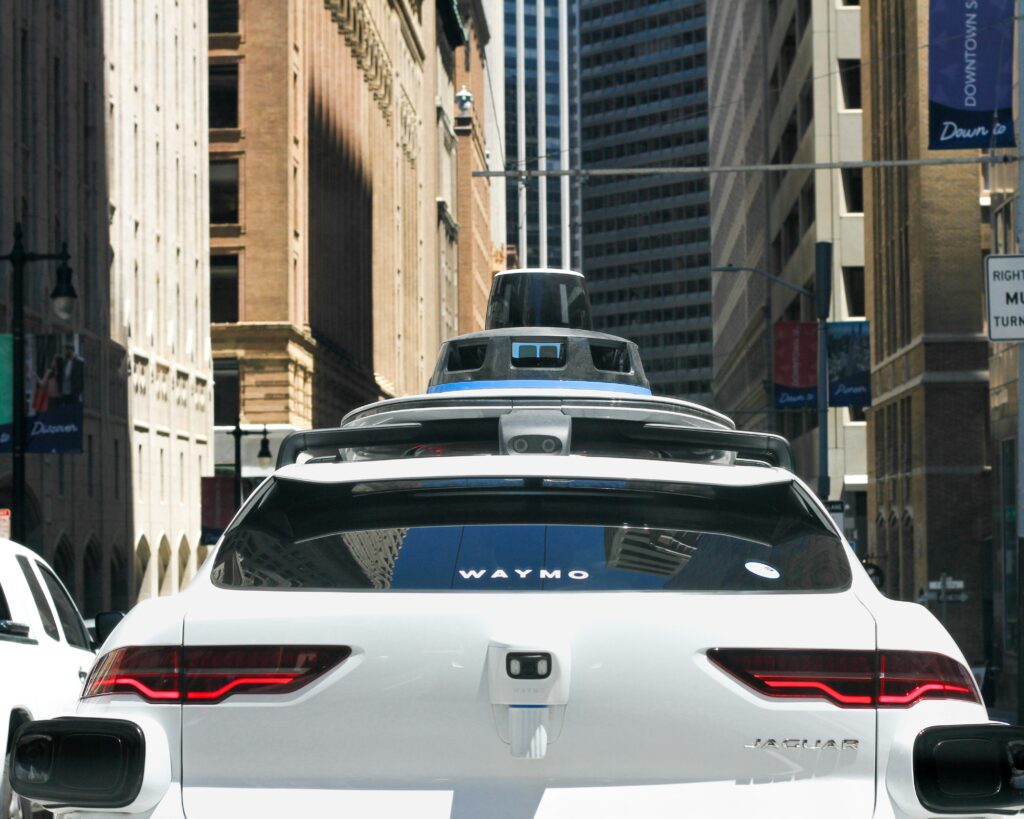
A Waymo accident is more disorienting than a typical collision — there’s no driver to exchange information with, no human face to put on the situation. Waymo, the autonomous vehicle company owned by Alphabet (Google’s parent company), is already operating a commercial robotaxi service in Phoenix, San Francisco, Austin, and Los Angeles, with more cities on the way. Tesla’s Full Self-Driving technology is on roads across the country. GM’s Cruise program, despite setbacks, continues to push forward.
With more autonomous vehicles (AVs) sharing the road every day, accidents involving self-driving cars are becoming a real and growing concern for everyday drivers. And if it hasn’t happened to you yet, it may be only a matter of time.
So, what do you do if a Waymo or another autonomous vehicle hits your car? Who is responsible? How do you file a claim? And critically, what happens to your car’s value after the accident?
This guide answers all of it, and if a Waymo accident happens to you, knowing your rights in advance makes all the difference.
First Things First: Treat It Like Any Other Accident
If a self-driving car hits you, your immediate steps are the same as any collision:
- Check for injuries. Call 911 if anyone is hurt.
- Move to safety if the vehicles are blocking traffic.
- Call the police. Get an official accident report, even if the damage seems minor. This is especially important with AV accidents because liability disputes are common.
- Document everything. Photograph the vehicles, damage, road conditions, street signs, and any visible sensors or cameras on the AV.
- Note the vehicle details. Record the make, model, license plate, and any identifying markings on the autonomous vehicle. Waymo vehicles, for example, are clearly branded with the company logo.
- Look for witnesses. Bystander accounts can be valuable since there is no human driver to provide a statement.
- Do not admit fault. Even in situations where liability seems obvious, say nothing that could be construed as an admission.
Who Is Liable When a Self-Driving Car Hits You?
This is where AV accidents differ significantly from standard collisions. In a typical accident, you file a claim against the at-fault driver’s auto insurance. With an autonomous vehicle, there is no human driver behind the wheel.
Liability in AV accidents generally falls into one of three categories:
1. The AV Company (Most Common)
If the vehicle was operating in full autonomous mode, the company that owns and operates it is typically liable. For Waymo, that means Alphabet. These companies carry substantial commercial liability insurance policies specifically for this scenario.
2. The Vehicle Manufacturer
If a defect in the vehicle’s hardware or software caused the accident, the manufacturer may share or bear full liability. This is similar to a product liability claim.
3. A Human Operator or Other Party
Some AVs still have a safety operator in the vehicle. If human error contributed to the accident, that individual and their employer may be liable. In rare cases, poor road conditions or another driver’s actions may shift partial liability elsewhere.
The key takeaway: you are not left without recourse simply because there was no human driver. These companies have legal and insurance obligations, and they know it. To see how specific insurers handle these situations, check our insurer database.
How to File a Waymo Accident Claim Step by Step
The claims process is more complex than a standard accident, but it is manageable if you know what to expect.
Contact your own insurance first. Regardless of fault, notify your insurer immediately. They can help guide the process and may pursue subrogation (recovering costs from the at-fault party) on your behalf.
Identify the AV company’s insurer. Waymo, for example, is self-insured up to a certain threshold and carries excess coverage above that. Their claims contact information should be accessible through the police report or by contacting Waymo directly.
File a third-party claim. Just as you would file against an at-fault driver’s insurer, you file against the AV company’s insurance. Be prepared for a more thorough investigation, since AV companies have access to detailed sensor data, camera footage, and ride logs from the vehicle.
Preserve your own evidence. Request copies of the police report, take photos immediately after the accident, and keep all medical and repair records. If your vehicle has a dashcam, save that footage.
Consult an attorney if liability is disputed. AV accident law is still evolving, and insurers for large tech companies have experienced legal teams. If the company disputes liability, having legal representation significantly improves your outcome.
The Part Most Accident Victims Miss: Diminished Value
Here is what almost no one tells you after a car accident, whether the other driver was human or a robot.
Even after your vehicle is fully repaired, it is worth less than it was before the accident.
This loss in market value is called diminished value, and it is real, measurable, and something you are legally entitled to recover in most states.
Buyers and dealers can see your car’s accident history on CARFAX and AutoCheck. That report does not distinguish between “hit by a distracted driver” and “hit by a Waymo.” All it shows is a reported collision, and that history permanently reduces what buyers are willing to pay and what dealers will offer on a trade-in.
If your car was worth $32,000 before the AV hit it and is now worth $27,500 after repairs, that $4,500 difference is your diminished value. You can claim it.
Does Diminished Value Apply the Same Way in AV Accidents?
Yes, and in some ways, it is easier to pursue.
In a standard accident, there can be disputes about fault that complicate a diminished value claim. In most AV accidents, the AV company accepts or is assigned liability relatively quickly because the vehicle data makes fault clear. That established liability is exactly what you need to file a valid third-party diminished value claim.
The process works like this:
- Get a professional diminished value appraisal. An independent appraiser calculates the difference between your car’s pre-accident market value and its current post-repair market value. This becomes the basis of your claim.
- Submit the appraisal to the AV company’s insurer. Include the appraisal report, your repair records, and documentation of the accident.
- Negotiate if necessary. Insurers, including those representing AV companies, will often make a low initial offer. A professional appraisal report gives you the evidence to push back.
- Get paid. Once the claim is settled, you receive compensation for the value your car permanently lost due to the accident history.
What AV Companies Don’t Want You to Know
Tech companies operating autonomous vehicle fleets are sophisticated, well-funded, and experienced at managing accident claims. They have data from every sensor, camera, and system on the vehicle. They will use that data to limit their exposure.
What they count on is that most accident victims do not know their full rights. Specifically:
- Most people do not know diminished value exists.
- Most people accept the first settlement offer without question.
- Most people do not get an independent appraisal.
Do not be most people.
The same tactics traditional insurers use to minimize payouts apply here. They may undervalue your vehicle, ignore diminished value entirely, or drag out the process hoping you will accept less just to be done with it.
Key Differences Between AV and Standard Accident Claims
| Factor | Standard Accident | AV Accident |
|---|---|---|
| At-fault party | Human driver | AV company or manufacturer |
| Insurance to file against | Driver’s personal auto policy | Commercial liability policy |
| Evidence available | Driver statement, witnesses | Sensor data, camera footage, ride logs |
| Liability clarity | Often disputed | Often clearer due to vehicle data |
| Diminished value applies | Yes | Yes |
| Settlement complexity | Moderate | Higher, due to corporate legal teams |
Bottom Line
Getting hit by a Waymo or any self-driving car is disorienting. There is no driver to exchange information with, no human face to put on the situation. But your rights are the same as in any accident, and in some ways the path to a fair settlement is more straightforward once you understand who is responsible and how to pursue them.
The biggest mistake you can make is assuming that because your car was repaired, you have been made whole. You have not, until you recover the diminished value your car permanently lost.
Do not leave that money on the table.
Was your vehicle damaged in an accident involving a self-driving car? MyFairClaim provides professional diminished value appraisals accepted by insurers nationwide. Get your free estimate today and find out exactly what your car’s accident history is costing you.
Get My Free Diminished Value Estimate →

James Andrews serves as Senior Claims Specialist at MyFairClaim, focusing on denial reversals and complex diminished value cases. With over 12 years of battling insurance company denials, he has developed strategies that overturn 73% of initial rejections. His expertise in turning “hopeless” denials into successful recoveries has helped thousands recover money insurance companies insisted didn’t exist.