
Reviewed by the MyFairClaim Claims Team · How we write and review
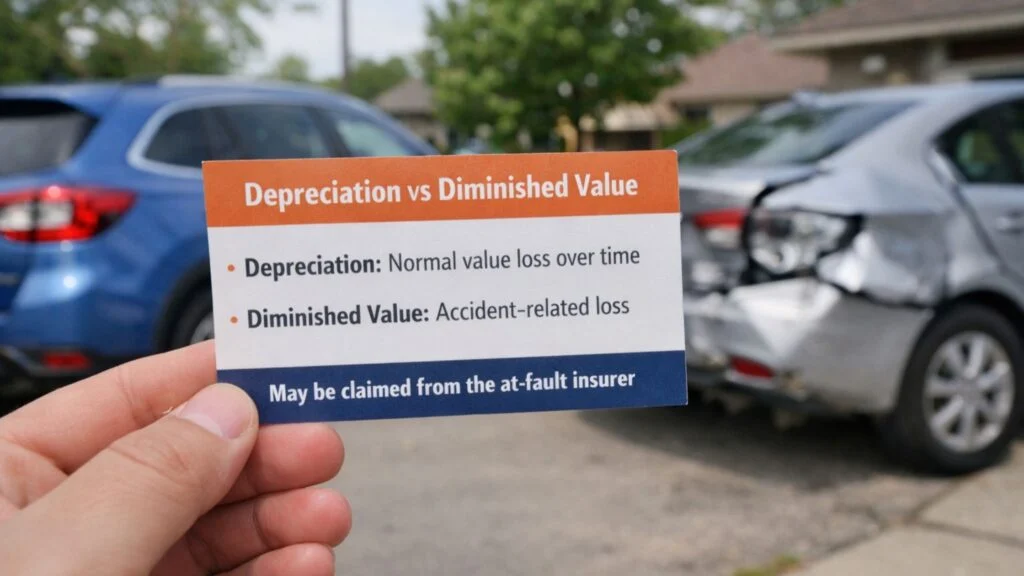
Short answer: yes, a car loses more value after a crash than from normal aging alone. Age and miles lower every car’s value. A crash on the record lowers it more, even after a good repair, because buyers pay less for a car with a reported accident. That extra drop is called diminished value. If another driver caused the crash, you can claim it from their insurer. Normal depreciation is never paid.
That second loss is your car's diminished value. Here is how a car diminished value claim works, from the appraisal to getting paid.
How big is the extra drop? In our October 2026 run on dealer listings near Atlanta, our method puts the loss on a 2022 Toyota Camry at 36,000 miles at $2,792 after a moderate repair and $3,578 after a structural one. The 17c formula most insurers use would offer $951 and $1,902 for the same car. See the figures for 17 popular used cars, or estimate what your own car lost.
Below are the questions car owners ask most often on Reddit and in car forums after an accident, answered straight.
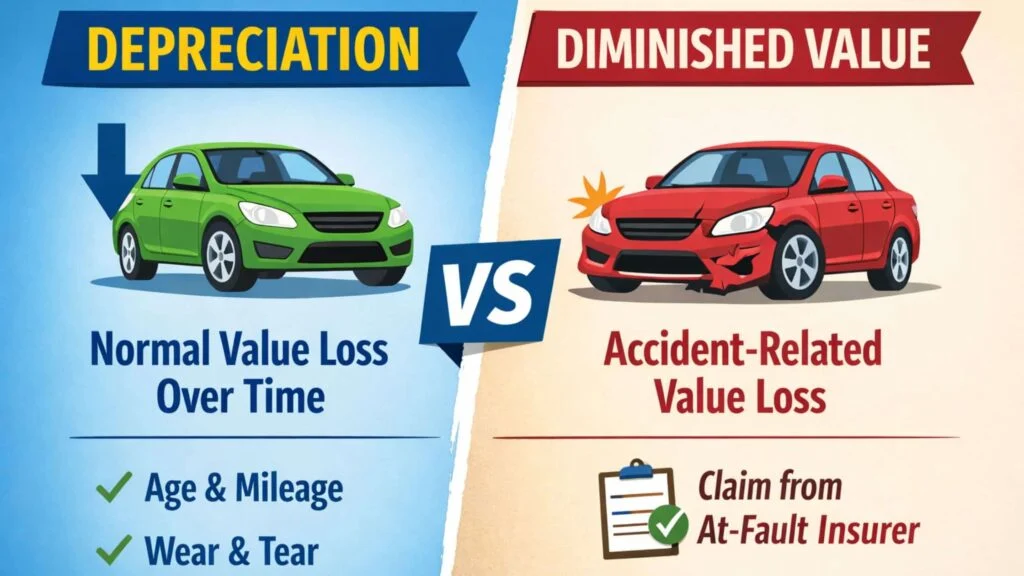
Normal Depreciation vs Accident Depreciation at a Glance
Depreciation is the natural loss of a car’s value over time due to age, mileage, and wear. Diminished value is the drop in market value after an accident, even if repairs are completed. Depreciation is not covered by insurance, but diminished value may be claimed from the at-fault driver’s insurer.
If you want to see the accident-related loss in dollars for common models, our diminished value data breaks it out vehicle by vehicle.
| Normal Depreciation | Accident Depreciation (Diminished Value) | |
|---|---|---|
| What causes it | Time, mileage and wear; happens to every vehicle | Accident history; only happens after a crash |
| Who is responsible | Nobody; it is normal wear | The at-fault driver and their insurer |
| How it’s measured | Market comparison over time (KBB, NADA) | Comparable sales gap: clean vs. accident-history vehicles |
| Can you recover it? | No; it is an expected loss | Yes, through a diminished value claim against the at-fault insurer |
| When it applies | Always, from the day you drive off the lot | Only after an accident caused by another driver |
My car was repaired perfectly. Does it still lose value?
Yes. A good repair fixes the car, but it can’t erase the accident from the car’s history. When you go to sell or trade in, the buyer sees an accident on the vehicle history report (or you tell them), and they offer less than they would for the same car with a clean history. Two cars with the same year, trim, mileage and condition sell for different prices based on that one fact.
That gap is diminished value. It’s separate from the repair bill, and the at-fault driver’s insurer doesn’t add it to your settlement on its own. You have to ask for it.
The accident isn’t on Carfax yet. Do I still have a claim?
Yes. Your claim comes from the damage and the repair, not from the Carfax listing. Carfax and other history reports often lag behind, sometimes by weeks or months, and some repairs show up later than you’d expect. The report catching up is only a matter of time.
It also doesn’t change what you’d have to tell a buyer. An honest seller discloses a repaired accident whether or not it’s on Carfax yet, and once a buyer knows, the price drops. The loss in value is real the day the car is repaired. How an accident on Carfax affects resale value goes deeper on this.
The adjuster says the drop is just normal depreciation. Is that true?
No. Normal depreciation is the value your car loses with time and miles, and it was happening before the accident. The drop caused by accident history is on top of that. The easy test: compare your car with the same model, year and mileage with a clean history. If the clean car sells for more, the difference isn’t normal depreciation, it’s the accident.
Insurers lean on the confusion in two ways:
- Picking similar cars that pull the value down. CCC ONE, Mitchell and Audatex, the three main tools insurers use, can pick cars with more miles or a lower trim. That takes off more value than the market does for your car.
- Calling the crash loss “normal depreciation.” Some adjusters say the drop after the crash is just normal aging. Sales of similar cars show it is not, and that is just what a diminished value appraisal proves.
Depreciation vs Diminished Value: an Example
Example: a 2022 Toyota Camry bought new for $28,000 is rear-ended at 2 years and 28,000 miles. The other driver is at fault.
| Value Component | Amount | What it is |
|---|---|---|
| Original purchase price | $28,000 | Dealer invoice |
| Normal depreciation (2 years, 28k miles) | −$7,200 | Market loss that happens regardless of the accident |
| Pre-accident value | $20,800 | The starting point for the diminished value calculation |
| Accident-caused diminished value (moderate damage) | −$2,500 to −$4,200 | Comparable sales gap; recoverable from the at-fault insurer |
| Post-repair market value | $16,600 to $18,300 | What buyers will actually pay |
The $7,200 of normal depreciation is your loss to absorb; it was happening before the accident and would have continued anyway. The $2,500 to $4,200 of accident-caused diminished value is what the at-fault driver’s insurer owes you.
Can I add my lost warranty time, repair delays or EV stigma to the claim?
Some of it, but not all in the same place, and where you put it matters.
Warranty time and downtime. Your factory warranty doesn’t pause while your car sits in a body shop. If the repair takes six weeks, that’s six weeks of warranty coverage you paid for and never got to use, and the warranty won’t be extended to make up for it. This belongs in your loss of use claim, which covers the time you were without your car, rather than in diminished value. Spell it out when you make that claim: adjusters won’t raise it for you.
EV stigma. This one is real, and much of it comes down to who did the repair. Electric vehicles need specific training, equipment and OEM parts, and not every body shop is certified for your make. If the work was done at a shop without that certification, or with non-OEM parts, buyers have a legitimate reason to pay less, and that supports a larger diminished value figure. Keep the shop’s certification status and the parts list with your claim. Why certified repairs matter for diminished value and our Tesla diminished value guide cover this in more detail.
Is a CarMax or Carvana offer enough proof?
It helps, but usually not on its own. An offer from a car buyer shows the accident hurt your car’s value, which supports your claim. The problem is who’s making the offer: a buyer is trying to get the best deal possible, so the number tends to come in low, and it isn’t a measurement of diminished value. Many insurers won’t accept it as sufficient proof.
A diminished value appraisal is different. It’s a neutral third-party valuation of the loss, built from comparable vehicles in your market, and it shows the adjuster how the number was reached. If you do collect dealer or online offers, keep them as supporting evidence alongside the appraisal.
How much of the loss do people actually get back?
There is no one honest number. What you get depends on the car, the damage, your state, the insurer and how well the loss is proven, so anyone quoting a flat percent is guessing. Proof is what makes the difference. An independent appraisal from MyFairClaim, plus the tools to make your case, lets you ask for the full diminished value instead of taking the insurer’s formula number. Our guide on how to get diminished value from insurance walks through the steps, including the demand letter.
Should I sign the property damage release first?
No. Don’t sign a property damage release until you’ve received the diminished value amount you’re pursuing. A release usually closes out the property damage side of your claim, and once it’s signed, you may not be able to go back for more.
Watch for one common move: the insurer sends a check for the “undisputed” amount, the part it already agrees with, hoping you’ll take it as the settlement. Don’t cash that check while you’re still negotiating. Once you and the insurer agree on the amount, sign the release so they can issue the payment. How long a diminished value claim takes explains what to expect along the way.
My car is leased. Do I need a diminished value claim?
Maybe not. On a lease, the leasing company owns the car, so the lost value is mostly their problem, unless you plan to buy the car at the end or your lease charges you for excess damage or lost value at turn-in. Read your lease and call the leasing company before you decide. Can you claim diminished value on a leased car? covers both cases.
I was at fault. Can I claim depreciation from my own insurer?
In most states, no. Diminished value claims are usually made against the at-fault driver’s insurer, and most policies don’t cover it for your own car. A few states and some policies are exceptions. Our diminished value filing guide explains when your own policy might pay.
My car was totaled. Do I get what I paid or what it’s worth now?
What it’s worth now. On a total loss, the insurer pays Actual Cash Value (ACV): what your car was worth on the day of the accident, after normal depreciation. That’s usually less than you paid and sometimes less than you owe. Your job is to make sure the ACV is right, because the common errors (comparables with higher mileage, excessive condition deductions, stale sales data) all push it down. How to read and dispute their depreciation calculation, or check the insurer’s total loss offer against real listings before you sign anything.
Gap insurance covers the difference between the ACV payout and what you still owe on your loan. It doesn’t cover diminished value, and if your car is repaired rather than totaled, gap insurance doesn’t apply at all.
Do I need a lawyer for a car-only claim?
Usually not. Most diminished value claims are handled directly with the insurer, and a lawyer typically takes a share of what you recover. An injury, a denied claim or a big gap that won’t close can change that. Do I need a lawyer for a diminished value claim? covers when it’s worth it.
Can I file a diminished value claim?
You likely qualify if:
- Another driver caused the accident
- Your car had measurable damage and was repaired
- Your car is relatively new or has low mileage
- Your state allows diminished value claims
Newer and pricier cars usually lose the most, because their buyers care most about accident history. File soon, and keep your repair records, photos and appraisal together.
See What Your Car Lost
If your car was in a crash you did not cause, do not count on the insurer to add diminished value to your payout. Start with the free diminished value calculator to see the gap between the 17c formula and your market loss. Then get a MyFairClaim diminished value report when you are ready to claim.
More on Diminished Value
Related Guides
- Free Diminished Value Calculator: estimate your loss in about 60 seconds
- How Much Does an Accident Decrease Car Value?: loss ranges by damage severity
- Car Insurance Depreciation Check: verify and dispute the insurer’s ACV
- How to Get Diminished Value from Insurance: step-by-step filing guide
- The 17c Formula, Explained: why the insurer formula undervalues your claim

The MyFairClaim Claims Team writes and reviews every guide on this site using official state sources and real local sales data. Each guide follows our published review process, and we update it when laws, court decisions or insurer practices change. Questions about a claim go to [email protected] or 602-935-4309.